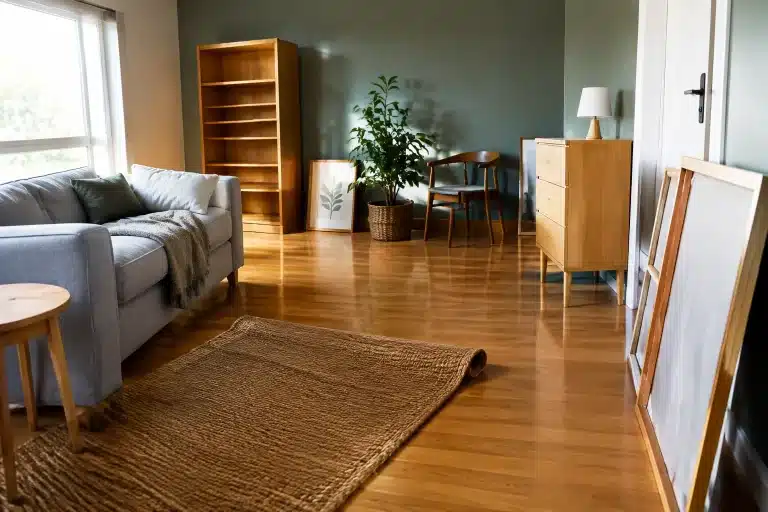


The dining room sideboard, Grandpa’s clock, the antique chest of drawers: these objects can become a source of tension at the worst possible time, just after a death. Two inheriting siblings, one coveted piece of furniture, and a question that casts a shadow over grief: who keeps it?
The answer hinges on a straightforward principle. This piece of furniture forms part of the estate and therefore belongs to all the heirs jointly until the estate is divided. No one can claim it solely without the agreement of the others, but practical solutions exist to resolve the matter quickly: mutual agreement, drawing lots, one heir buying out the other’s share (known as a soulte in some jurisdictions), or as a last resort, a court-ordered division through contentious probate proceedings.
Why a dispute over furniture can arise in an estate
A piece of furniture often has limited monetary value, but it carries strong sentimental weight. It is the centrepiece of family gatherings, the parents’ wedding gift, or a memento of cherished holidays. This emotional value, invisible on paper, explains why two heirs can become locked in conflict over the same object whilst other assets in the estate, sometimes far more valuable, provoke no disagreement whatsoever.
This type of family dispute reveals in fact an underappreciated area of law: until the estate is formally divided, none of the inheriting children has exclusive ownership of anything. Everything belongs collectively to the estate, which means an agreement or formal procedure must be found to resolve the situation.
The legal rules: who is entitled to what?
Without a will: joint ownership and equal division under intestacy rules
In the absence of a will, the law of intestacy sets out who inherits and in what proportions. The children generally inherit the estate in equal shares, including all personal chattels (furniture and household contents). This does not mean each child physically receives a share of the disputed item, but rather that its value must be fairly accounted for in the overall division of the inheritance.
In practice, if one of the two children keeps the furniture, the other must receive compensation of equivalent value, either in money or in other assets of comparable worth, so that the equality of the division is respected.
With a will: flexibility tempered by the inheritance rules
A will can designate a specific beneficiary for a particular piece of furniture. This wishes is normally honoured, but it is governed by the rules of inheritance law. A will cannot unfairly disadvantage an adult child to such an extent that they lose their lawful entitlement to a share of the estate, even if it assigns a specific piece of furniture to a sibling.
Agreeing a settlement: finding common ground between heirs
The quickest, least costly and least damaging solution for the family remains a negotiated settlement. It rests on the consent of all heirs, later formalised through a deed of variation or partition drawn up by a solicitor. The solicitor often plays a neutral role, able to defuse tensions by explaining the legal position and proposing balanced solutions.
Practical methods (drawing lots, one heir paying the other, exchanging items)
Several concrete methods allow the matter to be settled without prolonged conflict. Drawing lots has the advantage of being neutral and swift: nobody has “won” over the other, chance has decided. One heir buying out the other’s interest involves the child who keeps the furniture paying the other a sum equivalent to half its estimated value, often after a professional valuation. Alternatively, trading one item for another of equivalent value remains a practical option.
- Drawing lots to decide impartially without favouring either side
- One heir buying out the other’s share, compensating them financially
- Exchanging the item for another asset of similar value
- Selling the piece of furniture, with the proceeds divided between heirs
Removing the furniture from the family home before the other heirs have agreed, even to “protect it”, can be interpreted as a breach of duty and misappropriation of estate assets. This exposes the wrongdoer to civil claims and potential loss of rights to that asset.
Court-ordered division: when negotiation fails
When no agreement is reached, despite attempts at negotiation or proposals from the solicitor, each heir can apply to the County Court or the High Court (depending on the complexity and value of the estate) for a contested probate claim to force a formal division. The judge then examines the situation, may order a professional valuation to establish the value of the assets, and rules in accordance with the law of succession, without regard to emotional considerations.
This route is slower, often taking several months, and more expensive in solicitors’ fees and court costs. It also leaves lasting damage to family relationships, which is why solicitors systematically encourage heirs to exhaust all amicable options before resorting to court proceedings.
The costs of division: who pays what?
A negotiated settlement incurs legal and valuation costs, typically charged by the solicitor handling the matter. These costs are generally shared among heirs in proportion to their inheritance, unless they agree otherwise. A court-ordered division adds solicitors’ fees (mandatory in court proceedings), barristers’ fees if representation is required, and any professional valuation fees to assess disputed assets.
| Type of division | Approximate cost | Typical timeframe |
|---|---|---|
| Negotiated settlement | Solicitor’s charges, typically several hundred pounds | Several weeks |
| Court-ordered division | Solicitor and barrister fees, valuation, often several thousand pounds | Several months, sometimes over a year |
Advice for preventing the conflict from escalating
The best moment to prevent this type of dispute is shortly after the parents’ death, before positions become entrenched. Having a detailed inventory of the estate’s contents drawn up promptly, with an estimate of their value, helps to establish an objective framework from the outset. A neutral third party, such as a solicitor or a family mediator, often helps to defuse emotions before they become legal obstacles.
It is also worth noting that a division agreed between heirs is not necessarily permanent: a deed of division can, in certain circumstances, be challenged if one of the heirs believes they have been unfairly treated or if their agreement was not freely given at the time of signature. This possibility remains exceptional and is subject to strict time limits, which reinforces the importance of negotiating thoroughly at the first attempt to reach a settlement.